Wednesday, 4 June 2008

More Praise for McFadden!

Well, tonight's the night. The Griffin Prize for poetry will be announced, and of course I'm keeping my fingers crossed for Insomniac Press author, and friend, David W. McFadden. David gave a wonderful reading at the Macmillan Theatre and, despite his famous shyness, he seemed completely at home on the same stage as John Ashbery and the other heavy-weights, including Korean poet and freedom fighter Ko Un, who recieved the Griffin Lifetime Achievement Award last night to a standing ovation after a very moving tribute from poet Robert Hass. When he finally took to the podium, David's reading was so warm, funny, engaging, and entertaining, it seemed natural that his should be the final reading of what was a very wonderful night of poetry all around.

Over the weekend both the Ottawa Citizen and the Toronto Star ran profiles of David, saying many wonderful things about him and his book Why Are You So Sad? Selected Poems of David W. McFadden.

In the Toronto Star, Vit Wagner wrote:

It seems a curious coincidence Toronto poet David W. McFadden, a voracious reader since childhood, has lately been gorging on the prose fiction of Samuel Beckett.

Beckett, in addition to being one of the 20th century's greatest literary giants, famously shunned all displays of public recognition, even to the point of hiding out in Tunisia in 1969 when he could have been in Stockholm accepting the Nobel Prize for Literature.

It's unlikely McFadden will perform a similar disappearing act should he happen to be the Canadian winner of the $50,000 Griffin Poetry Prize on Wednesday – even if he does admit to being entirely unnerved by finding his name on the shortlist when it was announced last month.

"I have no idea why, but I had anxiety like I've never had before in my life," he allows, seated in a comfortable armchair during an interview earlier this week at Ben McNally Books. "I'm just a shy guy, I guess, but there has to be a lot more to it than that."

So great was McFadden's torment he privately began to fantasize the winning cheque would end up in the hands of one of this year's other two Canadian nominees, Robin Blaser or Nicole Brassard. (The international portion of the prize, also $50,000, will be awarded to one of John Ashbery, Elaine Equi, César Vallejo or David Harsent.)

"I so dreaded winning because I only have to give a speech if I win," he says. "I was constantly upset for three or four weeks, but I'm pretty relaxed now."

Relaxed maybe, but no less ambivalent.

You can read the whole article here.


And in the Ottawa Citizen, Donna Bailey Nurse wrote:

The collection illustrates McFadden's unique sensibility -- an extraordinary alertness to his surroundings, agitated by a hyperactive, surreal imagination, and deep anxieties regarding mortality and the passage of time. He is a relentless observer, and as if to symbolize this role, he wears a giant eyeball ring that stared boldly at me throughout our conversation.

McFadden has published several novels, short stories and plays and received his most popular success with two series of travel books, one involving tours around the Great Lakes and another, Innocent Abroad, which conveys the reader to Newfoundland, Ireland, Scotland and Cuba. Charming, whimsical, and full of quirky happenstance, McFadden's travel books illuminate his creative process -- the way he notices practically everything, and speedily transforms this experience into art. His celebration of the natural world and the commonplace likens him to the Romantic poets. Like William Blake, McFadden describes a world of innocence and experience, two states he attempts to reconcile.

You can read the whole article here.

Good luck tonight, David. I'll be cheering for you.

Photo: Ingrid Paulson.

Friday, 30 May 2008

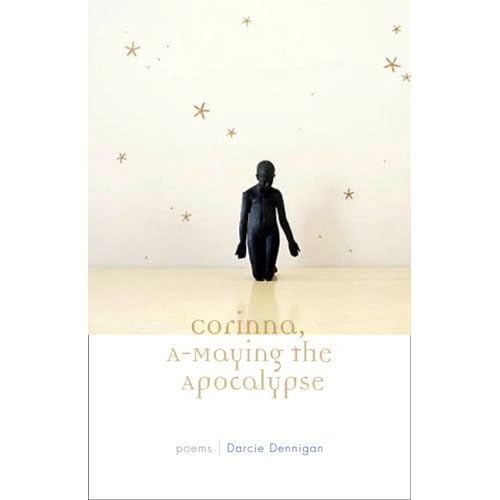
You should read Darcie Dennigan's Corinna A-maying the Apocalypse


I'm reading this book right now, and I'm enjoying it so much, I felt the need to spread the word. Rather than writing a full scale review of the book -- you already know that I like it, and critical overviews usually fail to describe the reasons for a reader's enthusiasm for a work, especially work that's as inimitable as Dennigan's delightfully idiosyncratic poetry (plus, no one is paying me to write one) -- I have assembled a round-up of poems and digital ephemera from the World Wide Web so you can get to know the work on your own. It's remarkably mature work for a first-time poet, and it's also fresh, affirmatively sinister, and an absolute pleasure to read. I recommend it highly.


POEMS

Corinna A-Maying the Apocalypse
Orienteering in the Land of the New Pirates
Bullet
Departure of Tenderness
Combatives #1 vol.2 (pdf)


REVIEWS
Slate
Coldfront


MISCELLANEOUS
Publisher's Listing
Poetry Daily Profile
The Canon Come Again (short article)
Poets Out Loud Prize

Order in Canada
Amazon.ca (Hardcover)
Amazon.ca (Paperback)

Order in the USA
Amazon.com (Hardcover)
Amazon.com (Paperback)

Minimum wage for Glasgow's underground poet

The Glasgow subway system would like its poet in residence to work 40 hours a week planning and executing literary events, selecting poems for display, and overseeing reading groups. This is all very wonderful, I suppose, but there's just one little problem. For such a large amount of work, the pay is CRAP! Here's a report from Charlene Sweeney at the TimesOnline:

It aims to produce underground literature, but according to some writers, the only thing subversive about a plan to recruit a poet-in-residence for Glasgow's subway system is the pay.
The scheme, thought to be the first of its type for public transport in Scotland, aims to enhance the travelling experience and promote the enjoyment of poetry. Authors praised the creative ambition behind the project, but pointed out that the £13,500 stipend for the 40 hours a week, nine-month residency was at best equivalent to the minimum wage.
The job will involve selecting poems to display in subway stations from existing work and establishing reading and writing groups to study and produce poetry. The successful candidate, who must have a “substantial publication record”, will also be expected to conduct writing workshops in local schools.
Read the rest of the story here.

Thursday, 29 May 2008

A very pleased Wendy Cope is profiled in The Independent

The following is excepted from The Independent:

Twenty two years after the publication of Making Cocoa for Kingsley Amis, the collection that shot her into what passes in the poetry world for a stratosphere, and 16 years after Serious Concerns, a book about disappointment that struck a chord so deep that it has sold more than 180,000 copies, Wendy Cope is happy. She has a sheen she didn't have when I first met her 20 years ago. You could call it poise, you could call it elegance but actually, I think it's just happiness. Happiness and love.

Her new book, Two Cures for Love: Selected Poems 1979-2006 (Faber & Faber, 12.99) takes its title from a poem in Serious Concerns which addresses, with Copeian brevity, the tricky issue of how to recover from that immobilising mental and physical condition called being in love. "Don't see him. Don't phone or write a letter," is the first option. The second,"The easy way: get to know him better," is characteristic understatement infused with a wry realism wrung from hard-won experience.

Read the whole piece here.

Wednesday, 28 May 2008

Walcott's "Mongoose" bites Naipaul

There are lots of ongoing literary feuds, but few of them are as weighty, or as nasty, as the one between Nobel laureates Derek Walcott and V.S. Naipaul. Recently, Walcott has taken the war of words into his poetry. In a poem called "Mongoose," Walcott takes direct aim. Here's a story from the Jamaica Gleaner:


Derek Walcott landed a poetic broadside on Trinidadian novelist V.S. Naipaul as he ended his 'Chatterbox' stint at the 2008 Calabash International Literary Festival on Saturday afternoon at Jake's in Treasure Beach, St Elizabeth.
The Nobel laureate for literature followed an onstage interview with Kwame Dawes with poetry from his upcoming collection, White Egrets, but a lot of the sting was in the tail as he closed with 'The Mongoose'.
It was quickly made clear that the beast he was referring to did not run around in literal cane pieces, as Walcott started the long poem with:
"I have been bitten
I must avoid infection
Or else I will be as dead
As Naipaul's fiction."
Walcott said the writer now worked with "a lethargy approaching the obscene" and observed "so the old mongoose still making money is a burnt-out comic", dismissing him as "a rodent in old age".
Read the rest of the story here.

UPDATE:
Here is a more in-depth view of the feud from Daniel Trilling at the New Statesman. Read it here.

Sunday, 25 May 2008

Because I said so

Spoken word performer Valentino Assenza has composed a response to my rant below, and with his permission I am posting a notice about it here on my blog. You can check it out on his website at http://valentino.coffeehouse.ca/. It's called "Because Paul Vermeersch Said So." Here is a sample:

I think it's time
I looked into a trade,
afterall,
I'm just not a poet anymore,

Sure,
I write things,
I've published a few poems
here and there,
hell,
I've even published
three books of poetry,
but I've learned today
that none of this is relevant.

I've read and performed my poetry
in cafes,
bars,
art galleries,
I've even had people
clap,
and even some cheer,

but what was it all for?

It all ends today,
see today,
Paul Vermeersch told me
I wasn't a poet.


I appreciate the directions an open dialogue can take, and I'm pleased with all the attention, positive and negative, that my screed has attracted. I invite readers to decide for themselves whether or not Valentino's composition works well as written poetry. I do find it curious that he would write the lines, "I feel guilty enough / as it is writing this in stanza form," when it isn't written in stanza form at all, but in a very loose kind of free verse with copious, irregular line breaks. Not that excellent poetry hasn't been written in that form, but it doesn't have anything to do with "stanzas."

I also question the choice of "famous" poets he invokes in his composition, seemingly as exemplars of the kind of "poetry" on which he has modelled his own work. They include: Charles Bukowski, Jim Carroll, Henry Rollins, Lou Reed, Bob Dylan, and Jim Morrison. It's interesting that most of them are well-known, and often greatly respected, figures in popular music, none of whom have ever enjoyed stellar literary reputations.

If I were reviewing this poem as a critic, I would have to say that I find Valentino's composition quite amusing, even funny, but I don't think it works very well on the level of poetry, and in many ways, I feel he is helping to make a lot of the points I've been trying to make about how a poet requires a dedication to poetic craft and to a lifelong study of the art of poetry. Whether or not you agree with me is, of course, entirely up to you.

Friday, 16 May 2008

10 Questions with Catherine Graham

As we get ready for the Insomniac Press poetry launch next week, Open Book Toronto offers us ten questions with poet Catherine Graham. You can check it out here.

Join Catherine Graham, Jason Camlot and Stuart Ross for the Insomniac Press / Punchy Writers Launch at Dora Keogh Traditional Irish Pub in Toronto on Wednesday, May 21. Visit Open Book Toronto's events page for details.

Also check out Jason Camlot's blog here.

And even alsoer, check out Stuart Ross's's blog here.

I hope to see you, yes you, at the launch!

Sunday, 4 May 2008

The skull in poet Schiller's tomb is not Schiller's

From Deutsch Welle:

DNA tests prove that a skull venerated by many literature lovers as the "brainbox" of 18th-century German dramatist Friedrich Schiller actually sat atop the shoulder's of a very different man, a German official said.

Genetic material was taken in 2006 from the skull, kept in a tomb in Weimar, central Germany, where Schiller and fellow author Johann Wolfgang Goethe lived, and compared to material from the graves of Schiller relatives.

Schiller (1759-1805), who wrote influential plays critical of inequality, has no direct descendants still alive.


The skull was recovered from a royal courtiers' mass grave in Weimar 21 years after his death as a cult developed around him, and it was treated for 180 years as Schiller's, based on many points of resemblance to his appearance.

"The DNA analysis shows without a shadow of a doubt that this is not the author's skull," Julia Glesner, a spokeswoman for the Weimar Foundation which preserves the German Classicist heritage, said on Saturday, May 3.

Adding to the mystery is a controversy over a second skull found in 1911 in the same mass grave, regarded by some as Schiller's. But the DNA tests found it too belonged to someone else.


Read the whole story here.

And The Local here.